Values Before Techniques: A Values-First Approach to Persistent Anxiety
For over 15 years, I have worked with people with anxiety, including clients who felt like they were failing therapy itself. They did what they were told to do: exposure work, breathing, mindfulness, relaxation. Many worked hard and still felt stuck.
Those are often the sessions where someone says, "I am doing everything right, why am I not getting better?"
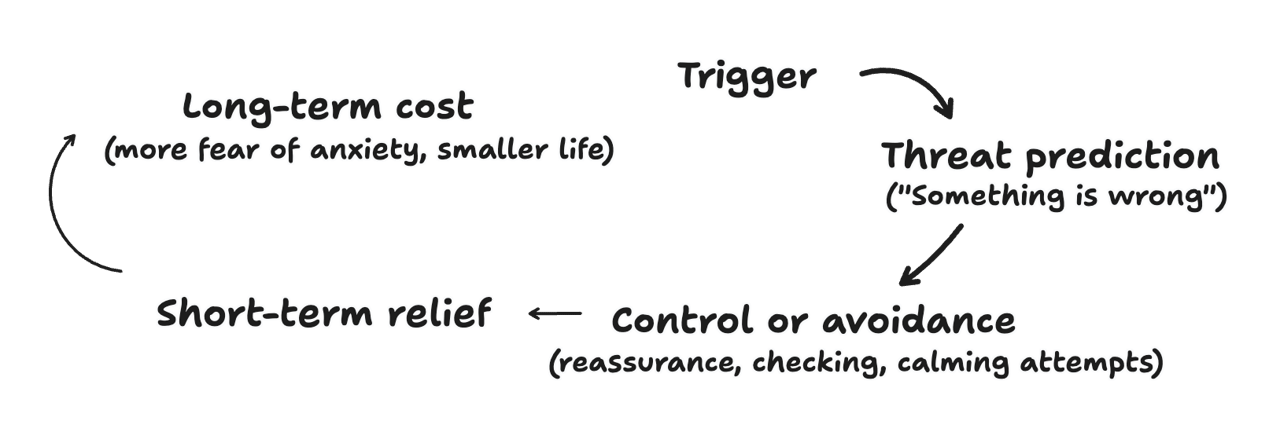
When treatment gets framed as "push through this so anxiety goes away," it can backfire. In my practice, the harder someone tries to remove anxiety, the more central anxiety becomes.
This guide argues for a different starting point: values before techniques.
With chronic or severe anxiety, many coping tools can carry a hidden message: anxiety is a problem you need to fix before you can live. That message increases shame when distress stays high. A values-first approach keeps therapy focused on direction and function, not on whether anxiety disappeared.
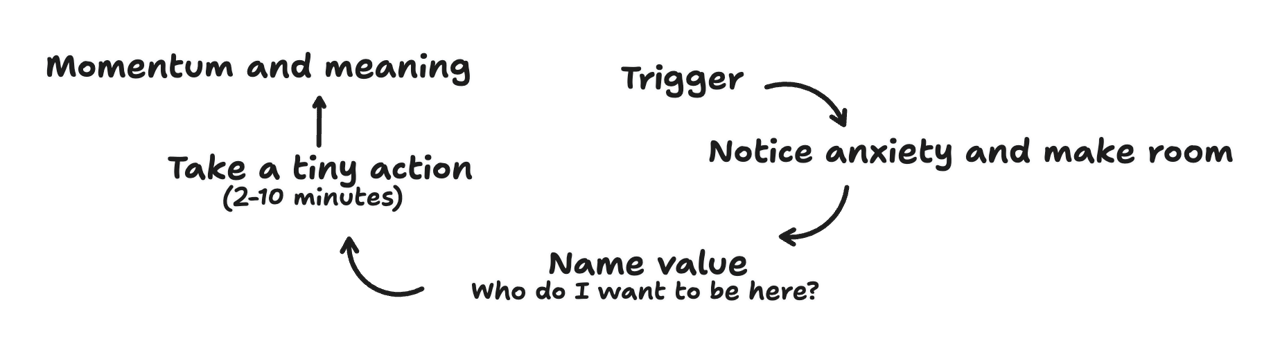
In ACT terms, the sequence is simple: open up, unhook, and move. Make room for anxious sensations, notice anxious thoughts as thoughts, then take a values-guided step with anxiety still present.
Why coping and regulation strategies can backfire
With severe, sustained anxiety, many clients end up living by one rule:
I cannot live until I feel better.
Even well-meant regulation strategies can reinforce that rule. Every attempt to "calm down first" is communicating to your brain that anxiety itself is dangerous. Then the person has two problems: the original anxiety, and fear of anxiety spikes. Therapy can quietly become a pass/fail test: Did the technique remove anxiety? When the answer is no, clients often conclude the technique failed, the therapist does not understand, or they are beyond help.
A better working question is:
"Did this move me 1% toward the life I want, even with anxiety here?"
If symptom reduction is the only scorecard, distress feels like failure. If direction matters most, progress is still possible on hard days.
A simple sequence for severe, sustained anxiety
This is a short, repeatable flow you can use in-session and adapt as an "in-the-moment" plan.
| Step | What to do | Therapist prompt | Success metric |
|---|---|---|---|
| 1) Name the loop | Map the pattern in plain language: trigger (X), prediction (Y), and response (Z). | "When X happens, what do you predict, and what do you do next to avoid or control it?" | The loop is specific enough to recognize in real time. |
| 2) Name one value | Identify one direction anxiety is squeezing, using a single word or short phrase. | "If anxiety were not running this moment, what would this part of life stand for?" | The value gives direction, even if anxiety stays high. |
| 3) Tiny action (2 to 10 minutes) | Choose the smallest values-aligned action that is doable with anxiety present. | "What is the smallest version you could do for two minutes, even badly?" | Client starts and completes a concrete action, not a mood-fix strategy. |
| 4) Functional debrief | Review function, not feelings, and plan the next small step. | "Did this move you 1% toward the life you want, and what made it easier or harder?" | Progress is tracked by direction and follow-through, not symptom elimination. |
1) Name the anxiety loop in plain language
Keep it concrete and non-pathologizing:
- Trigger: "When X happens..."
- Prediction: "...I predict Y..."
- Response: "...so I avoid or control Z."
Example:
"When I get an email from my boss (X), I predict I am about to be fired (Y), so I spend hours rereading my work and avoid starting anything new (Z)."
This usually lowers shame and shows where intervention is possible without arguing about whether the fear is true.
Quick worksheet for session:
- X (trigger): "When _____ happens..."
- Y (prediction): "...I predict _____"
- Z (response): "...so I avoid or control _____"
- Value being squeezed: "_____"
- Tiny next step (2 to 10 minutes): "_____"
2) Identify one value anxiety is squeezing
Ask: "If anxiety were not running the show, what would this part of life stand for?"
You are not looking for the perfect value, just language that creates direction.
Values are ongoing directions, not boxes to check.
Examples:
- adventurous
- independent
- reliable
- supportive
- curious
- caring
- engaged
Often the value is already inside the anxiety story:
- "I cannot stop worrying about my kids" -> loving / protective / mindful
- "I am obsessing about my health" -> responsible / engaged / persistent
- "I cannot handle uncertainty at work" -> skillful / reliable
3) Commit to a tiny values-aligned action (2-10 minutes)
Set constraints clearly:
- Doable with anxiety present
- Small enough to start
- Not heroic
- Action-focused, not mood-focused
Micro-move ladder:
- 2 minutes: Start the smallest version.
- 5 minutes: Stay with the action a little longer.
- 10 minutes: Add one more step while anxiety is still there.
Examples:
- If the value is supportive: send a two-sentence text, sit in the same room as your partner.
- If the value is independent: pay one bill, open the document and write one sentence.
- If the value is caring: make a simple meal, take meds.
- If the value is curious: read one page, write three questions instead of seeking certainty.
When clients say "I cannot," I usually ask:
- "What is the smallest version you could do for two minutes?"
- "If you were allowed to do it badly, what would it look like?"
At first this can feel clunky. The point is to practice living while anxiety is present.
4) Debrief functionally, not emotionally
After the action, debrief in a way that reinforces the new stance:
- "Did this move you 1% toward the life you want?"
- "What helped you start?"
- "What got in the way, and what would make the next step easier?"
Notice what is not asked:
- Not "Did it calm you down?"
- Not "Were you mindful enough?"
- Not pass/fail language.
This protects clients from the trap where distress automatically means failure.
Why this is not "never soothe"
A values-first approach does not mean white-knuckling through life. A warm shower, a walk, or a call with a friend can all be helpful. The problem starts when every action gets framed as anxiety control.
The distinction is practical: a walk because you value being outdoors is living. A walk used only to force anxiety down can become another struggle with internal experience.
If clients cannot find language for values
Some clients get stuck at "I do not know what matters," especially after years of anxiety-led decision making.
In those moments, a values discovery tool can help with vocabulary. I sometimes use the values.guide list of values as a conversation starter, not a prescription.
Frame it like this:
- "Let us find words that feel like you."
- "We are looking for direction, not a perfect answer."
- "We will test it through action, not inspiration."
The core shift
For severe, sustained anxiety, a more workable focus is often this: take small steps toward a life that still feels worth living, while anxiety is present, instead of waiting for symptoms to settle first.
This approach often reduces anxiety over time. Less shame, less avoidance, more follow-through. It works best when anxiety is no longer treated as the enemy.
Want more articles like this?
Get concise guidance to help you act on what matters most.